LS Engine Guide
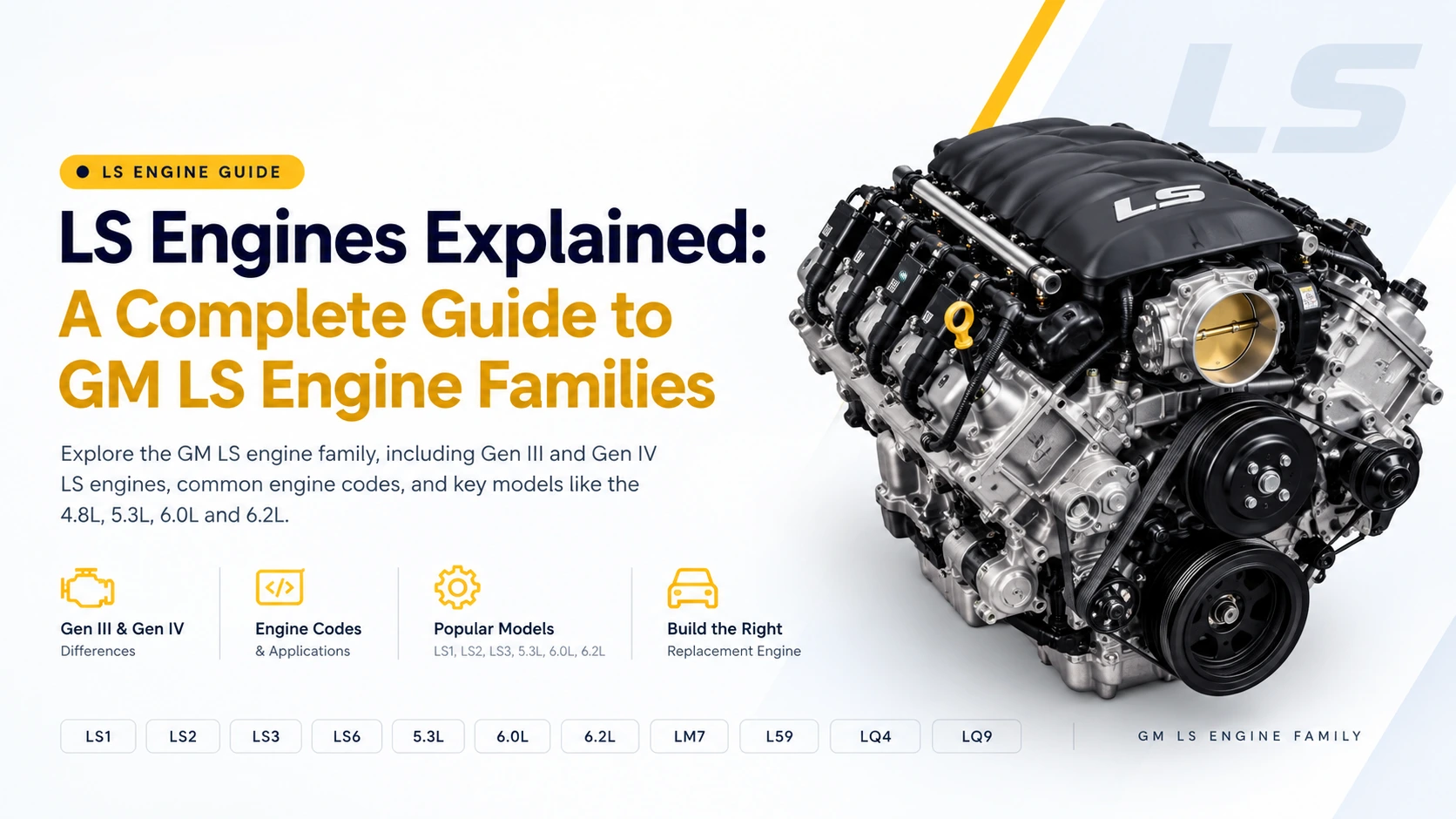
LS Engines Explained:
A Complete Guide to GM LS Engine Families
The GM LS engine family includes some of the most widely known
small-block V8 engines ever produced by General Motors. From the
LS1 and LS6 to truck engines such as the LM7, L59, LQ4 and LQ9,
understanding the different engine codes and generations is
essential when identifying, replacing or comparing an LS engine.
1997
LS Era Begins
The LS platform debuted with the LS1.
III
Gen III LS
Includes engines such as LS1, LM7 and LQ4.
IV
Gen IV LS
Expanded the architecture with newer technologies.
4.8–7.0L
Wide Range
Different LS-based engines covered many applications.
The term LS engine can be confusing because not every
engine commonly described as an LS actually carries "LS" in its RPO
code. General Motors' modern small-block platform includes passenger
car engines, truck engines and performance variants with different
displacements, cylinder heads, blocks, fuel systems and control
strategies.
GM introduced the LS1 in 1997 as part of its new-generation small-block
V8 architecture. The platform then expanded into numerous Gen III and
Gen IV engines used across Chevrolet, GMC and Cadillac vehicles.
GM's own LS-series material describes this broader family as the
company's Gen III and Gen IV small-block architecture. :contentReference[oaicite:1]{index=1}
For anyone buying a replacement engine, the most important lesson is
simple: do not identify an LS engine by displacement alone.
Engine code, generation, application, block type and vehicle fitment
can all matter.
!
Why "LS" does not tell you everything
A 5.3L, 6.0L or 6.2L engine can belong to different LS-family
configurations. Always verify the specific RPO/engine code and
application before selecting a replacement engine.
What Is the GM LS Engine Family?
The GM LS engine family refers broadly to General
Motors' Gen III and Gen IV small-block V8 architecture that became
widely known through engines such as the LS1, LS6, LS2, LS3 and many
related truck and SUV engines.
The first production engine in the modern LS era was the
5.7L LS1, introduced for the 1997 model year. It was
followed by additional performance, passenger-car and truck
derivatives. GM's own technical material identifies common LS-family
characteristics including 4.400-inch bore centers, six-bolt
cross-bolted main bearing caps and coil-near-plug ignition. :contentReference[oaicite:2]{index=2}
The architecture became especially important in trucks and SUVs,
where engines such as the LM7, L59, LQ4 and LQ9 became
common choices.
Gen III vs Gen IV LS Engines
One of the easiest ways to understand the LS family is to separate it
into its major generations. Gen III engines came first, while Gen IV
introduced several architectural and control-system changes.
First Modern LS Generation
Gen III LS
Gen III engines began with the LS1 and expanded into numerous
car and truck applications.
- LS1 and LS6 performance engines
- LR4 4.8L truck engine
- LM7 5.3L truck engine
- L59 5.3L flex-fuel engine
- LQ4 and LQ9 6.0L engines
- Other application-specific variants
Expanded LS Architecture
Gen IV LS
Gen IV expanded the LS architecture with additional
displacements and technologies, including applications using
cylinder deactivation and variable valve timing.
- LS2 and LS3 performance engines
- LS7 7.0L performance engine
- 6.0L and 6.2L truck/SUV variants
- 5.3L applications
- AFM-equipped configurations
- VVT-equipped configurations
GM's LS-series documentation identifies 2005 as the beginning of the
Gen IV branch, with differences including revised camshaft-position
sensing and, on many Gen IV blocks, provisions associated with Active
Fuel Management. :contentReference[oaicite:3]{index=3}
Common GM LS Engine Codes Explained
The engine's RPO code is one of the most useful ways to distinguish
different LS-family engines. The following table highlights several
important examples rather than attempting to list every LS-based
engine GM produced.
| Engine Code |
Displacement |
Generation |
Common Application |
| LS1 |
5.7L |
Gen III |
Corvette, Camaro and other performance applications |
| LS6 |
5.7L |
Gen III |
Corvette Z06 and CTS-V applications |
| LR4 |
4.8L |
Gen III |
GM trucks and vans |
| LM7 |
5.3L |
Gen III |
Silverado, Sierra, Tahoe, Yukon and related vehicles |
| L59 |
5.3L |
Gen III |
Flex-fuel truck and SUV applications |
| LQ4 |
6.0L |
Gen III |
Heavy-duty trucks, SUVs and vans |
| LQ9 |
6.0L |
Gen III |
Performance truck and SUV applications |
| LS2 |
6.0L |
Gen IV |
Corvette, GTO, SSR and performance applications |
| LS3 |
6.2L |
Gen IV |
Corvette, Camaro and performance applications |
| LS7 |
7.0L |
Gen IV |
Corvette Z06 and high-performance applications |
Application ranges vary by model year and vehicle. This is why a
replacement-engine buyer should use the engine code and exact vehicle
information rather than assuming that any engine with the same
displacement is interchangeable. GM's own LS material documents a
broad range of car and truck applications across the platform. :contentReference[oaicite:4]{index=4}
LS1 and LS6: The Original Performance LS Engines
The LS1 is the engine that established the modern LS
platform. It displaced 5.7 liters, or 346 cubic inches, and appeared
in vehicles including the Corvette and Camaro/Firebird applications.
The LS6 followed as a higher-performance 5.7L variant.
It shared the same basic displacement but used a distinct block and
other performance-oriented components. GM documentation identifies the
LS6 as a separate branch of the early LS performance family. :contentReference[oaicite:5]{index=5}
These engines are important because they established many of the
design characteristics and aftermarket interest that later made the
LS platform so widely recognized.
5.3L LS Engines: LM7, L59 and Other Variants
The 5.3L LS engine is especially important for
replacement-engine buyers because GM produced several different
5.3L configurations.
The LM7 and L59 are two of the most recognizable Gen III 5.3L
truck engines. Both are 5.3L V8s with iron blocks, but the L59 was
produced for flex-fuel applications. Technical application data
places the LM7 broadly in 1999–2007 truck, SUV and van applications,
while the L59 appears in flex-fuel applications during the Gen III
period. :contentReference[oaicite:6]{index=6}
Other 5.3L variants include the aluminum-block LM4 and L33, along
with later Gen IV 5.3L engines. These differences demonstrate why
simply searching for a "5.3 LS engine" is not enough when ordering
a replacement.
LM7
5.3L Vortec 5300
A widely used Gen III 5.3L truck and SUV engine. Common
applications include Silverado, Sierra, Tahoe, Yukon,
Suburban, Yukon XL and GM vans.
L59
5.3L Flex-Fuel
A Gen III 5.3L engine associated with flex-fuel applications.
Correct application and fuel-system identification are important
when selecting a replacement.
LM4
5.3L Aluminum
An aluminum-block Gen III 5.3L variant used in selected
SUV, truck and performance-oriented applications.
L33
5.3L HO
An aluminum-block 5.3L Gen III variant with different
specifications from the common LM7 truck engine.
LH6
Gen IV 5.3L
A later 5.3L configuration associated with Gen IV architecture
and technologies such as Active Fuel Management.
LC9
Later 5.3L Variant
Another Gen IV-era 5.3L configuration illustrating how
application-specific differences continued across the platform.
LQ4 and LQ9: The Gen III 6.0L Engines
The LQ4 and LQ9 are two important
6.0L Gen III truck-based LS engines.
The LQ4 was used in a range of heavy-duty truck, SUV and van
applications. The LQ9 was a higher-output 6.0L variant associated with
applications including the Cadillac Escalade and performance-oriented
GM trucks and SUVs.
Although both engines share a 6.0L displacement, their specifications,
compression, applications and calibration differ. Technical references
list the LQ4 and LQ9 as separate RPO codes within the Gen III family. :contentReference[oaicite:7]{index=7}
LS2, LS3 and the Gen IV Performance Family
Gen IV expanded the performance side of the LS platform considerably.
The LS2 introduced a 6.0L Gen IV configuration in 2005,
while later engines such as the LS3 brought the
displacement to 6.2 liters.
GM's LS-series documentation identifies the LS2 as a 6.0L Gen IV
engine and lists later performance engines including the LS3, LS7 and
supercharged LS9. :contentReference[oaicite:8]{index=8}
The important point for replacement-engine buyers is that a performance
LS engine and a truck LS engine may share the broader architecture
while having substantially different applications and components.
Other Important LS Engine Variants
The LS family became much larger than the original LS1 and LS6. Some
variants were developed for specialized vehicle applications, while
others were designed for high-performance use.
LS4
5.3L Front-Wheel Drive
A specialized 5.3L Gen IV LS application designed for
front-wheel-drive vehicles.
LS7
7.0L Performance
A 7.0L naturally aspirated high-performance Gen IV engine
associated with the Corvette Z06.
LSA
6.2L Supercharged
A supercharged 6.2L Gen IV performance engine used in
high-output applications.
LS9
6.2L Supercharged
A highly specialized supercharged 6.2L LS engine developed
for the Corvette ZR1.
L92
6.2L Truck/SUV
A 6.2L Gen IV engine associated with selected GM truck and
SUV applications.
L76
6.0L Gen IV
A Gen IV 6.0L configuration used in both passenger and
truck-related applications.
How to Identify an LS Engine
Identifying the correct engine code is one of the most important steps
when shopping for an LS replacement engine. Depending on the vehicle,
identification information may be available through the vehicle
documentation, engine markings or VIN-related information.
Start With the Vehicle
Collect as much information as possible before searching for
the replacement engine.
- Model year
- Make and model
- Trim or application
- Drivetrain
- VIN information
Then Identify the Engine
Compare the engine identification information with the product
listing before ordering.
- RPO / engine code
- Displacement
- Block material
- Fuel system
- Generation
Same displacement does not always mean same engine.
For example, several GM engines use the 5.3L displacement while
having different RPO codes, block materials, generations,
applications and control systems. Always verify exact fitment
before purchasing a replacement engine.
Are Vortec Engines Part of the LS Family?
This is one of the most common points of confusion. Many GM truck
engines carry the Vortec name rather than an "LS"
name, even though they are based on the Gen III or Gen IV small-block
architecture commonly grouped into the LS family.
For example, the LM7 is commonly known as the Vortec 5300 while also
being considered part of the Gen III LS/Vortec family. The same
distinction applies to engines such as the LQ4 and LQ9.
This is why searching for both the RPO code and the Vortec/LS
designation can be useful when researching replacement engines.
Why 5.3L LS Engines Matter for Replacement Applications
The 5.3L platform is particularly relevant to replacement-engine
buyers because it was used across a large range of Chevrolet, GMC and
Cadillac vehicles.
Gen III examples include the LM7 and L59, which appeared in trucks,
SUVs and vans across multiple model years. Technical application
references list vehicles such as the Silverado, Sierra, Tahoe,
Suburban, Yukon, Yukon XL, Avalanche, Express and Savana among their
applications. :contentReference[oaicite:9]{index=9}
However, the exact application matters. A 5.3L replacement engine
should be selected according to the original engine code and vehicle
configuration rather than displacement alone.
You can explore Mechron Tech's
LS Engines
category to see available LS-family replacement engine options.
Buying an LS Replacement Engine? Check These Details
If you are shopping for an LS replacement engine, use the following
checklist before placing an order.
LS Engine Compatibility Checklist
Verify these details against your original engine and vehicle.
- Exact vehicle model year
- Vehicle make and model
- Original engine RPO code
- Engine generation
- Displacement
- Block material
- Fuel system
- Drivetrain configuration
- VIN/application information
- Required external components
- Product fitment information
- Warranty and return terms
Continue Your LS Engine Research
Understanding the LS family is only the first step. If you are
researching a specific 5.3L engine, continue with the more focused
guides below.
Frequently Asked Questions About LS Engines
What is an LS engine?
"LS engine" is commonly used to describe GM's Gen III and
Gen IV small-block V8 family, including both engines with LS
RPO codes and related truck and SUV variants such as the LM7,
L59, LQ4 and LQ9.
What generation is the LM7?
The LM7 is a Gen III 5.3L V8 commonly associated with GM
trucks, SUVs and vans from the late 1990s through the 2000s.
What is an L59 engine?
The L59 is a Gen III 5.3L V8 associated with flex-fuel
applications. It is closely related to the LM7 but should be
identified by its specific RPO code and vehicle application.
Is a 5.3L engine an LS engine?
Many GM 5.3L engines are part of the broader Gen III or Gen IV
LS/Vortec architecture. However, several different 5.3L RPO
codes exist, so the exact engine should be identified before
purchasing a replacement.
What is the difference between Gen III and Gen IV LS engines?
Gen IV introduced several architectural and control-system
changes compared with Gen III, including revised camshaft
position sensing and, on many applications, provisions for
technologies such as Active Fuel Management and variable valve
timing.
Are LM7 and L59 the same engine?
They are closely related Gen III 5.3L engines, but they have
different RPO codes and application characteristics. The L59
was used for flex-fuel applications, so buyers should verify
the exact engine code and vehicle requirements.
How do I choose the correct LS replacement engine?
Start with the original engine code, vehicle year, make,
model, drivetrain and displacement. Then compare the
replacement engine's specifications and fitment information
before ordering.
Looking for the Right LS Replacement Engine?
Once you know your engine code and vehicle application, explore
Mechron Tech's LS engine collection to find replacement options
matched to your requirements.
Explore LS Engines →
Important:
Engine applications, specifications and fitment can vary by model
year, vehicle configuration and engine code. Always verify the exact
application before purchasing a replacement engine.