Replacement Engine Guide
What to Check Before Buying a
Replacement Engine
Buying a replacement engine is a major decision. The right engine
should match your vehicle, specifications, application and
installation requirements. Before placing an order, learn what to
check so you can avoid compatibility problems, unexpected costs
and unnecessary delays.
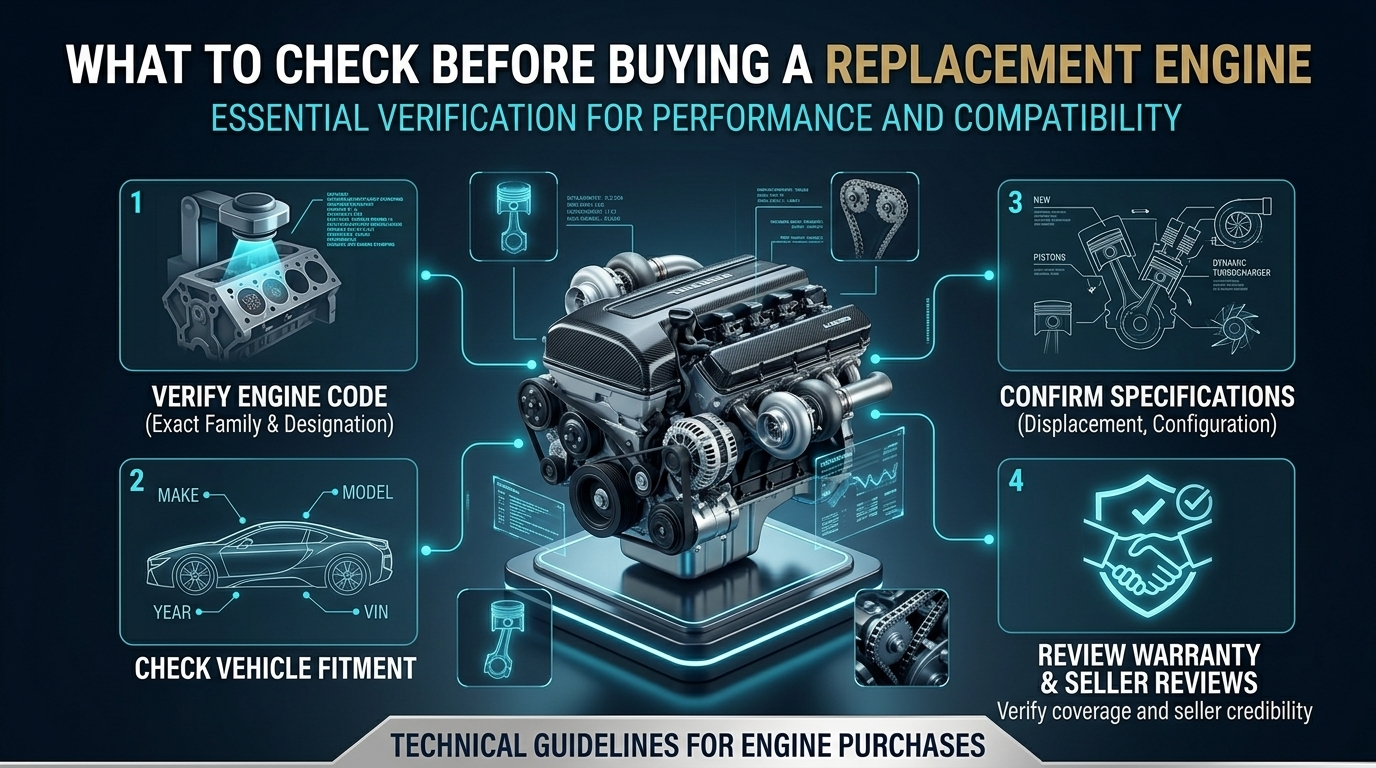
01
Engine Code
Confirm the exact engine family and code.
02
Vehicle Fitment
Verify year, make, model and application.
03
Specifications
Compare displacement, configuration and equipment.
04
Seller Details
Review condition, warranty and ordering terms.
Choosing a replacement engine is not simply a matter of finding an
engine with the same displacement. A 5.3L engine, for example, can
exist in several different configurations, generations and engine
codes. Two engines may have the same displacement but still require
different components or may not be compatible with the same vehicle.
That is why knowing what to check before buying a replacement
engine is just as important as comparing prices. Checking
compatibility, engine identification, specifications, condition,
warranty coverage and installation requirements before ordering can
help you make a more informed purchase.
In this guide, we will walk through the most important points to
verify before purchasing a replacement engine for your vehicle.
!
Do not rely on engine size alone
Engine displacement is only one part of compatibility.
Always verify the engine code, vehicle application, model
year, drivetrain and other relevant specifications before
ordering a replacement engine.
1. Confirm Your Vehicle’s Exact Fitment
The first and most important step is confirming exactly which vehicle
the replacement engine is going into. Start with the vehicle’s
year, make, model and drivetrain.
Even within the same model year, manufacturers may offer multiple
engine configurations. Four-wheel-drive, all-wheel-drive, two-wheel
drive, heavy-duty and different emissions configurations can affect
engine compatibility.
01
✓
Model Year
Verify the exact production year of the vehicle. Do not assume
that an engine listed for a similar model year will automatically
fit your application.
02
✓
Make & Model
Confirm the manufacturer, model and trim or application when
available. Vehicle-specific fitment information is more useful
than relying only on engine displacement.
03
✓
Drivetrain
Check whether your vehicle uses 2WD, 4WD or AWD. Drivetrain
configuration can affect the correct replacement engine and
related components.
04
✓
Application
Commercial, passenger, performance and heavy-duty applications
may use different configurations. Match the replacement engine
to the intended application.
2. Find Your Engine Code
One of the most important things to check before buying a replacement
engine is the engine code. The engine code can identify
a specific engine family or configuration and can be more useful for
compatibility than displacement alone.
For example, GM 5.3L engines can include different engine codes such
as LM7 and L59. Although both are 5.3L V8 engines, their applications
and specifications are not necessarily identical.
Why the engine code matters
When comparing replacement engines, use the original engine code
as one of your primary identification points. Depending on the
vehicle, you may be able to find the engine identification on the
engine itself, vehicle documentation or manufacturer information.
Engine Family
Identifies the broader engine platform.
Engine Code
Helps distinguish specific configurations.
VIN Information
May provide additional application details.
If you are researching GM LS engines, our
LS Engines
category provides a useful starting point for exploring compatible
replacement engine options.
3. Compare the Engine Specifications
Once you have confirmed the engine code, compare the major
specifications of the replacement engine with your original engine.
This is especially important when several engines have similar
displacement.
| Specification |
What to Check |
| Displacement |
Confirm the engine size, such as 5.3L or 5.7L. |
| Engine Code |
Match the correct engine family and configuration. |
| Cylinder Configuration |
Verify the number of cylinders and engine layout. |
| Fuel System |
Check whether the engine uses the required fuel system. |
| Valvetrain |
Compare the relevant valvetrain configuration. |
| Drivetrain |
Confirm compatibility with the vehicle’s drivetrain. |
| Emissions Configuration |
Check application-specific emissions requirements. |
4. Understand What the Replacement Engine Includes
Not every replacement engine is supplied in exactly the same
configuration. Before buying, find out what is included in the
assembly and what components will need to be transferred from your
original engine.
- Engine block
- Cylinder heads
- Crankshaft
- Pistons and rings
- Camshaft where applicable
- Timing components
- Oil pump
- Gaskets and seals
- Oil pan where specified
- Timing cover where specified
- Valve covers where specified
- External accessories and components
The exact configuration varies by product, so always review the
individual product description and fitment information before ordering.
If you are unsure about what is included, contact the seller before
completing the purchase.
5. Check Whether the Engine Is Used, Remanufactured or Rebuilt
The condition and preparation process of a replacement engine can make
a significant difference in what you are purchasing. Sellers may offer
used, rebuilt or remanufactured engines, and these terms should not be
treated as interchangeable.
Used Engine
- Typically removed from another vehicle.
- May retain original internal components.
- Condition and mileage can vary.
- History may depend on the source vehicle.
Remanufactured Engine
- Disassembled and inspected.
- Components can be measured and evaluated.
- Machining may be performed where required.
- Worn or unsuitable components can be replaced.
For a deeper comparison, read our guide:
Remanufactured vs Used Engines: What’s the Difference?
6. Review the Remanufacturing or Rebuilding Process
If you are considering a remanufactured replacement engine, look beyond
the word “remanufactured.” A useful product description should explain
what happens during the preparation process.
Look for information about cleaning, inspection, machining,
measurement, replacement components and final testing. These details
provide a better understanding of how the engine was prepared before
being offered for sale.
01
Cleaning
Components should be thoroughly cleaned so the engine can be
properly inspected and prepared for assembly.
02
Inspection
Major components should be inspected for wear, damage,
cracks and dimensional condition.
03
Machining
Components requiring machining should be restored to the
applicable specifications and measured during the process.
04
Testing
Ask whether the finished engine is tested or inspected before
shipment and what final quality checks are performed.
7. Check the Warranty and Return Policy
Warranty coverage is another important factor when buying a replacement
engine. However, do not assume that every engine has the same warranty
terms.
Before ordering, carefully review the warranty period, mileage limits
if applicable, covered components, exclusions, installation
requirements and claim procedures.
- How long is the warranty?
- Is there a mileage limitation?
- Which components are covered?
- Are labor costs covered?
- Are installation requirements specified?
- What maintenance is required?
- How are warranty claims handled?
- What happens if the engine must be returned?
8. Understand the Engine Core Requirement
Some replacement engine programs involve a core return. A core is the
original engine or qualifying component that may need to be returned to
the supplier after the replacement engine is installed.
Before ordering, check whether a core charge applies, whether your
original engine qualifies, how the return is arranged and who is
responsible for shipping costs.
Understanding these terms before purchasing can help prevent unexpected
charges after delivery.
9. Check Shipping and Delivery Requirements
Replacement engines are heavy automotive components, so shipping is
different from ordering a normal consumer product. Before placing an
order, check how the engine will be packaged, shipped and delivered.
01
Packaging
Understand how the engine is secured for transport.
02
Delivery
Check the available delivery method and destination.
03
Inspection
Inspect the shipment when it arrives.
04
Damage
Know how shipping damage should be reported.
10. Compare the Replacement Engine With Your Original
Before installation, compare the replacement engine with the original
engine whenever possible. This can help identify differences before the
old engine has been removed or before the replacement is installed.
- Engine code
- Block configuration
- Cylinder head configuration
- Oil pan arrangement
- Timing cover configuration
- Mounting locations
- Sensor locations
- Accessory mounting points
- Intake and exhaust configuration
- Required transferred components
11. Ask the Seller the Right Questions
A professional seller should be able to provide clear information
about the engine’s application, condition and specifications. If an
important detail is unclear, ask before placing your order rather than
assuming the engine will fit.
01
Is this engine compatible with my exact vehicle?
Provide the year, make, model, engine code and drivetrain
when requesting confirmation.
02
What engine code does this replacement use?
Confirm that the replacement matches the required
application.
03
What exactly is included?
Confirm whether the product is supplied as a long block,
complete engine or another configuration.
04
What is covered by the warranty?
Review the actual warranty terms before purchasing.
05
Is a core return required?
Ask about core eligibility, charges and return procedures.
06
What should be transferred from my original engine?
This can help you prepare for installation and avoid
unexpected parts requirements.
Replacement Engine Buying Checklist
Before you complete your purchase, use this quick checklist to make
sure you have verified the major details.
- Confirmed vehicle year
- Confirmed vehicle make and model
- Confirmed drivetrain
- Identified original engine code
- Compared engine specifications
- Verified product fitment
- Confirmed what is included
- Reviewed engine preparation process
- Checked warranty terms
- Checked core requirements
- Reviewed shipping information
- Asked questions about unclear details
Why Proper Fitment Matters
The goal of a replacement engine is not simply to find an engine that
physically resembles the original. The replacement must be appropriate
for the vehicle’s application and work with the required components,
systems and drivetrain configuration.
Taking time to verify fitment before buying can make the ordering and
installation process much smoother. It can also help you avoid the
additional time and expense associated with receiving an incompatible
engine.
If you are still determining which engine your vehicle requires, our
guide on
How to Choose the Right Replacement Engine for Your Vehicle
can help you work through the selection process.
Frequently Asked Questions
What should I check before buying a replacement engine?
Check the vehicle year, make, model, drivetrain, engine code,
displacement, specifications, fitment, included components,
engine condition, warranty, core requirements and shipping
terms before purchasing.
Is engine size enough to determine compatibility?
No. Engine displacement alone does not always identify the
correct application. Engine code, model year, drivetrain and
other specifications should also be verified.
How do I find my engine code?
Depending on the vehicle, the engine code may be available from
engine identification markings, vehicle documentation or
manufacturer information. When in doubt, provide your vehicle
identification details to a qualified parts specialist.
What is the difference between a used and remanufactured engine?
A used engine is generally removed from another vehicle and sold
based on its existing condition. A remanufactured engine is
disassembled, inspected and prepared through a rebuilding or
remanufacturing process, with components evaluated and replaced
or machined where required.
Should I check the warranty before buying an engine?
Yes. Review the actual warranty terms, including duration,
limitations, covered components, installation requirements and
claim procedures before completing the purchase.
Should I confirm fitment before ordering?
Absolutely. Confirming fitment before ordering is one of the
most important steps when buying a replacement engine. Use the
exact vehicle and engine information available to you.
Explore Mechron Tech Engine Resources
Looking for more information before choosing a replacement engine?
Explore our
Engine
collection and
LS Engine
category for additional replacement engine options.
You can also read our related guides:
Need Help Finding the Right Engine?
If you are unsure which replacement engine matches your vehicle,
verify your vehicle details and contact Mechron Tech before placing
your order. Providing accurate engine and vehicle information helps
ensure you are looking at the correct application.
Get Help With Fitment →
Important: Vehicle fitment information should always
be verified against the exact application before ordering. Specifications
and included components can vary by engine and vehicle configuration.
If you are unsure about compatibility, contact a qualified parts
specialist before purchasing.